April 18, 2011

Bradford Pear

I apologize for the infrequent posts, but I’ve been doing a great deal of research lately.  I am still trying to wrap my head around the statistical information I am finding for each species.  What do these numbers truly mean to me the woodworker and how will they aid my understanding of a species that I have yet to work with?

One of the trees that I planned to discuss is the Bradford Pear (Pyrus calleryana).  I have a love/hate relationship with this tree.  It is one of the species that is hard to find concrete numbers on, and, for this reason, I was planning to delay posting about it even though it is a great follow up to the Redbud, but this week changed my plans.

My home state of Oklahoma is well known for its windiness, but Friday April 15, 2011, was ridiculous!  We had 40 mph sustained winds, with confirmed gusts to 70+ mph!!!  Are you beginning to see where this is headed?

We have (had) two straggly Pears along our driveway that we should have removed years ago, but they are blocking the view of a telephone pole.  Friday, half of one of the trees collided with our house.  That was the last straw.  I promptly felled the remainder of that tree (and its neighbor).  Twenty-four hours later the trees are completely gone.  The stumps have been ground.  The lawn has been repaired.  And the wood has been cut into turning blanks and sealed with Anchorseal. 


It was not how I had intended to spend my Friday and Saturday, and while the entire episode perfectly illustrates all that I hate about this species, I am quite excited by all of the Pear wood that I now have!


As I said, I have a love/hate relationship with Bradford Pear.  I love it once it is wood, but there are so many things that I hate about it as a tree.  I try to avoid being negative, but what follows is a short list of my grievances.

First off, let me say that I am using the term “Bradford” Pear quite loosely.  They are generically “Callery” Pears with many cultivars, which are supposed to be an improvement to the flowering pear.  “Bradford” just seems to be the most common varietal planted around here. 

This brings me to my first gripe.  This tree has been overplanted in the suburban landscape, at least where I live.  I don’t know if landscape architects were initially to blame or if the popularity coincided with the rise of the home improvement big box store, but these trees are everywhere.  Granted, they are quite striking with their profuse white flowers in the early spring, but the flowers are absolutely putrid smelling, with an odor similar to decaying flesh.  I have even heard that the nectar within these flowers is so thin and of such little value that honeybees will bypass the Bradford unless they have no other options.


My second gripe is that each of these flowers produces a small hard berry (presumably some sort of berry-shaped pear), but interestingly, I have never seen these consumed by birds or other wildlife.  They simply rot on the tree and drop off in the late fall, leaving behind a royal, slimy, nasty mess.


My third gripe is that the overall canopy shape is nearly identical from tree to tree.  They remind me of a bunch of lollipops jammed into the ground in Candyland.  They have very little character! 


My fourth gripe is that they are notoriously short lived, with a reported average lifespan of 25 years.  Huh…guess how many growth rings my trees had!!!  Bradfords must have been very popular in 1986, because there are many mature specimen around here that now look distressed. 

The fifth gripe may correlate with the fourth - the wood is brittle.  You can count on severe tree damage with any ice storm or wind event.  And that is where I stand today.  I will discuss this more when I post about the actual wood, but Pear has a very high specific gravity (0.73), which is comparable to Persimmon and only slightly less than Hedge (our hardest domestic hardwood).  This may be why the tree is considered brittle.  The wood may be too strong to bend and, instead, ruptures catastrophically.


Identification:

The tree has simple alternate leaves of about 2 ½” with a waxy/shiny appearance and subtly serrated margins.


The bark is smooth and dark gray on young trees and twigs but develops to become neatly and narrowly furrowed.


The fall foliage ranges from orange to purple.


More about the wood of the Bradford in the next post. 

April 3, 2011

Redbud #2

The redbud may indeed be the poster child for Discovering Wood.  It is one of those woods that you have to kind of “luck into”.  You can’t go to the average lumber supplier and buy 110 board feet.  Even small owner-operated mills are rarely going to have Redbud lumber in any quantity, BUT it is a perfect example of the domestic exotics that we can harvest and mill in our own shops.

I “happened upon” a large redbud trunk early last summer when a storm decimated the over 100-year-old tree standing in my father-in-law’s farmyard.  The original owner of the property said that her grandfather specifically planted the Redbud sometime in the 1890s.  The center of the trunk had been ravaged by ants, termites, or some form of wood-eating insect over the years, and this is probably what ultimately made the trunk susceptible to wind damage.  The logs had already been bucked into two-foot lengths when I arrived, which precluded any long lumber, but what remained was perfect for home milling.  I retained some of the largest chunks and burls for turning blanks (along with any other chunky bits) and milled a fair bit into thin lumber. (More on my process in future posts).


The Numbers:

Specific Gravity
Density (#/cf)
Janka Hardness
“Shrinkage Ratio”
0.6363
39.65
1000?
???


The reported specific gravity is 0.6363 (comparable to Ash) and density of 39.65 #/cubic foot (comparable to Walnut).  I’m trying to figure out exactly what these figures mean.  One source implies that specific gravity is the most important predictor of wood strength.  I thought it just determined if it would float (ala Salem witch trials).  I am equally unsure about the density figure, although I might expect it to relate to hardness or dent resistance.  If you have any insight, please let me know.  The other figure I came across is the Janka hardness scale (measured in pounds (or kilograms) of force required to press a roughly ½” diameter steel ball into the wood ¼”), although I have been unable to find a Janka number for Redbud.  If the Janka number correlates in any way with density, then we might assume that Redbud’s Janka is approximately 1000 (ie. softer than Red Oak but harder than Red Cedar) which is about how I would say that it behaves.

The other thing I have noticed is that Redbud has a tendency to split as it dries (even when the endgrain is sealed).  I have not had this issue with boards (although my boards are approx. ½” thick), but chunks left for turning are prone to split.  I am still working out what numbers would lend a predictability to this tendency.  On other species, I have seen numbers for the percentage of shrinkage from green to dry (both tangential and radial); perhaps the predictor is a ratio of these two numbers, as it would define shrinkage stresses.  I will investigate this further.  For now, let’s call this the “shrinkage ratio”.

Please bear with me as I compile and define some of these “technical” details.


Freshly milled boards.  The top board is partially planed.

On the practical side:

The most surprising thing about Redbud is the color. The wood is a mid to dark brown with streaks of red, yellow, and chocolate brown.  It is stunning.  There are surely growing condition and soil composition factors that determine how the wood ultimately looks.  I don’t know what those are, but I have seen an array of appearances in Redbud lumber from different sources.  I found the wood to be fairly fine-grained.  It is a little harder to carve than Black Walnut, but it does hold crisp detail.


"Redbud Leaves" 2010

On an interesting note, Hoadley mentions Redbud among a handful of other specieswhich fluoresce under ultraviolet light.  I bought a “blacklight” light bulb from Home Depot and had a lot of fun looking at different woods (I have several of the species); most fluoresce yellow and are really cool to look at but very difficult to photograph.  I can only imagine how it would look under a more powerful UV source, such as a woods lamp.
Redbud's yellow fluorescence under UV light.

March 23, 2011

Springtime

I’ve been debating which tree to start with, and then the answer came to me quite suddenly.  Less than two weeks ago, the world where I live was still stuck in the greys of winter, but then it suddenly began to explode with the colors of spring.  In my area, the eruption of color begins with the Bradford Pear (definitely a tree worth addressing later) followed by forsythia, daffodils, crabapple and dogwood.

They are all welcome harbingers of spring, but absolutely nothing compares with the shocking vibrancy of the Redbud tree (Cercis canadensis).  Perhaps it is simply that it is the state tree of my home state of Oklahoma that warms the cockles of my heart. 

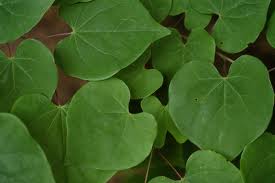
It abounds in so much of the surrounding manmade landscape because of its beautiful spring showing, but it offers multi-seasonal interest as well:  1) The leaves are nearly perfectly heart shaped. 


2) The bark is fairly smooth with a slight fishnet appearance on the young tree and branches, developing into small flat scales as the tree matures and its diameter increases.  If the scales are disturbed or removed, the underbark is a distinctive reddish-brown. 

3) The Redbud also bears a seedpod through much of the winter, which resembles a flattened pea-pod and is often borne in clusters. 


Raised in “captivity,” these cultivated Redbuds are often asked to survive out in the open, far away from their preferred place in the understory, protected by the strong Oak or stately Ash.  Subject to the strong Oklahoma winds, these contorted single or multi-stemmed trees take on an almost bonsai quality.

The redbud also abounds in the native landscape and pierces the darkness of the otherwise leafless forest, beckoning hikers to wander the understory.  They are so prevalent in nature that it is said that they were once used as a delineator of USDA hardiness zones.  They say that you can tell which zone that you are in based on when your redbuds begin blooming.  I personally associate the arrival of its blossoms with the arrival of Easter.  While the Dogwood is reportedly most intimately associated with the actual crucifixion, one of the nicknames of the Redbud is the “Judas Tree” as some people believe that Judas Iscariot hanged himself after his betrayal from a related tree Cercis siliquastrum. 

Most of us would never consider Redbud as a viable source of wood.  I’ve lived around them my entire life and have never found a piece in the firewood pile.  You certainly won’t find it in a commercial lumberyard.  Large diameter Rebuds are not very common, although the National Register of Big Trees reports a tree in Jackson, MO that stands 39 feet tall with a circumference of 132 inches (a little math tells me that that is 42 inches in diameter).  Wow!  That may call for a road trip!

I intend to discuss each subject species over several posts, primarily to allow discoveries of information along the way.  This includes information tendered by my readers.  If you have personal experience, please feel free to add to this or any discussion in the comments section.

Next time, we will get into a discussion about the wood from the beautiful Redbud.


March 17, 2011

A Little About Me

I guess that I should tell you a little about me.  First and foremost, I am an avid woodworker.  Like I mentioned in my first post, I have been working with wood for more than 25 years (and I’m only forty!).  I started back in high school with a scrollsaw, in Dad’s shop, during the heyday of country décor, cutting goose shapes from pine for my Mom’s craft business.  It paid quite well, and, as it was paid per piece, I became quite fast.  I fell in love with wood, and soon, I was watching Norm and Roy on PBS.  Two of my earliest solo projects were a pine bookcase (made with power tools and mortise and tenon joints ala Norm Abrams) and a rustic hickory log headboard (made completely with hand tools ala Roy Underhill). 


When college came along, I took a brief “sabbatical” as I had no money and little time.  I re-entered woodworking after college, finding myself with more time, but even less money.  I continued along the Neander/Luddite trail primarily because I could produce rustic and log furniture with a drawknife, a chisel, a drill and a handplane for very little money, BUT I always aspired to have Norm’s shop. 
Over the years, I began to accumulate some of Norm’s tools and found myself with a two car garage capable of producing, quite literally, almost anything my heart desires.  I have done a little bit of everything, from small jewelry boxes to huge cabinet jobs, and while I would never want to compete with the big cabinet shops, my hobby has literally paid the bills from time to time. 
Historically, my favorite things to design and build have been craftsman furniture, in the vain of L&JG Stickley, Limbert or Greene and Greene, because my formative wood lusts sprang from the “Tiger Oak” (quartersawn oak) Arts and Crafts antiques in my parent’s home.  Few materials speak to me more!  I longed to work with it just as I had longed to have Norm’s shop. 
My dreams came true to the extent that when opportunity arose, I purchased a used Timberking B20 sawmill so that I could custom cut my own quarter and rift sawn oak.  The sawmill, however, broadened my horizons as it gave me occasion (and desire) to work species such as walnut, maple and sycamore.

I have dabbled with almost every wood working discipline through the years, but for some reason avoided woodturning until recently.  Perhaps it was because everyone who mentioned it also mentioned how addictive it can be.  I was just having too much fun exploring the many avenues of woodworking to forsake them all just to watch wood spin.  As I mentioned in my first post, I was led to woodturning when I decided to finally fulfill a dream of building a set of five Windsor chairs for my family.  I had never even played with a lathe, and the learning curve was initially steep, but I threw myself headlong into learning spindle-turning techniques.  In fairly short order, I was ready to begin making all of the legs (20), stretchers (15) and armposts (10) necessary for my project.  While those parts dried in my homemade kiln, I had time to foray into bowl turning (and I have barely looked back.  They were right…it is addictive!)

Woodturning has opened incredible doors for me.  The sheer spontaneity of bowl turning greenwood has led me to “open-up” logs from species that I would have never even considered working with.  This has led to both successful and…well…less-than-successful pieces. But, it has also led to a thirst for knowledge.

March 13, 2011

An Introduction

It is a bit intimidating to start with this blank slate. 

I’m not much of a writer.  My wife is the English major with a masters in Speech-Communication who taught composition and grammar.  Whoa…now maybe that is why this is a bit intimidating!  I believe I’ll have to forego her critiques and corrections, or I believe I would freeze at the possibility of making a grammatical mistake.  Nevertheless, as I was saying, I’m not much of a writer, and I’m not really looking for a new hobby (blogging).  I am an avid woodworker of nearly 25 years (and I’m only 40).

A recent bucket-list foray into building a set of five Windsor chairs for my family awakened a curiosity of wood species.  I think that prior to this I realized that different species have different properties, but I had been approaching wood mainly for its color palette (maple = blonde and walnut = brunette).  The Windsor is the poster child for wood technology.  Traditional Windsors are usually constructed from at least three, and as many as five, different types of wood, each selected because it excelled in a particular area:  oak bends beautifully; maple turns crisply; pine carves easily… (I built my Windsors from white oak, hackberry, ash and poplar).  This opened a whole new train of thought for me and left me with a number of questions about a subject that I thought I knew something about…wood. 

I emerged from the Windsor wormhole with two new passions:  a passion for woodturning and a passion for experiencing new species.  There are so many tree species that I know very little about.  I want to know more about the woods readily available to me.  I want to better learn how to accurately identify trees and lumber.  I want to learn everything I can about how I should expect these woods to behave.  What are their positive and negative attributes?

This is where the blog arises.  I have read several of the “right” books; I have read Hoadley’s Identifying Wood cover-to-cover.  I have been to several of the “right” web sites; I have often perused Purdue’s thorough website.  I have talked to several of the “right” people; My Grandpa is a treasure-trove of tree knowledge.  But, for some reason, the in-depth knowledge I seek doesn’t seem to stick, and many of the sources that I reference don’t contain information directed at woodworkers.  That fact was driven home after I retrieved several sections of mystery log from a nice lady’s yard. 


Planera aquatica (Water Elm)?


She had no idea what kind of tree it had been, and the tree service had removed all of the secondary information necessary to make a diagnosis using a forestry service handbook.  As I looked through the handbook, I became frustrated.  Even after Grandpa identified the wood as Water Elm, the handbook had almost no useful information for me, the woodworker!  “Light brown with thick whitish sapwood, fine textured, lightweight, soft.  Scarce and not used locally”DOES NOT HELP!!!

I want to right this wrong in my life.  I don’t really care to work with exotic woods from the rainforest, but I do want intimate working knowledge of exotic woods from the local urban forest!  I want to learn to ID the trees around me.  I want to obtain sample logs from a whole host of native and ornamental species.  I want to turn these samples.  I want to mill these samples.  I hope to chronicle the discoveries of my journey.  Hopefully, it will be informative to you as well.